How Will We Recognize the "Move 37" of AGI? Demis Hassabis on the 50% Probability of Human-Level Intelligence by 2030
Key points
Demis Hassabis predicts a 50% chance of AGI by 2030. True AGI requires cognitive consistency across tens of thousands of tasks and the ability to perform independent scientific discovery. Progress relies on scaling pre-training, post-training, and inference-time compute while utilizing AI for energy and hardware optimization.
Key takeaway
The path to Artificial General Intelligence (AGI) is transitioning from a phase of "jagged intelligence" to one of "unified cognitive consistency." Demis Hassabis posits a 50% probability of reaching this milestone by 2030. This evolution is not merely an engineering feat of scaling compute, but a fundamental scientific challenge requiring breakthroughs in reasoning and creative invention. The ultimate validation of AGI will be its ability to achieve "lighthouse moments"—such as independently deriving the laws of relativity or inventing games as profound as Go. As AI begins to optimize its own architecture and solve physical-world challenges like nuclear fusion and material science, the distinction between human and machine discovery will continue to blur.
The Road to AGI: A 2030 Vision by Demis Hassabis
The quest for Artificial General Intelligence (AGI) has reached a critical juncture where the timeline for its arrival is no longer a matter of distant speculation but a statistical probability. Demis Hassabis, a central figure in the field, estimates that there is a 50% chance we will achieve AGI within the next five years, specifically by the year 2030.
Defining and Recognizing AGI
This estimation brings to the forefront a fundamental question regarding how humanity will actually recognize when the threshold of AGI has been crossed. The transition from current specialized models to a fully general system requires a shift away from what Hassabis describes as "jagged intelligence". Today's systems may perform at superhuman levels in specific domains, yet they remain flawed, inconsistent, and lack the cross-domain reliability found in the human brain. To meet the high bar of AGI, a system must match the collective cognitive functions of the human mind, which acts as a general Turing machine capable of building modern civilization.
The Two-Tiered Validation Framework
To validate the existence of a true AGI, Hassabis proposes a two-tiered testing framework:
Tier 1: Brute Force Assessment — Encompassing tens of thousands of cognitive tasks that are known to be manageable for humans.
Tier 2: Qualitative Expert Analysis — Making the system available to several hundred of the world's top subject-matter experts (such as mathematician Terence Tao) for months to identify any obvious flaws or "holes" in its intelligence.
"Lighthouse Moments": The New Move 37
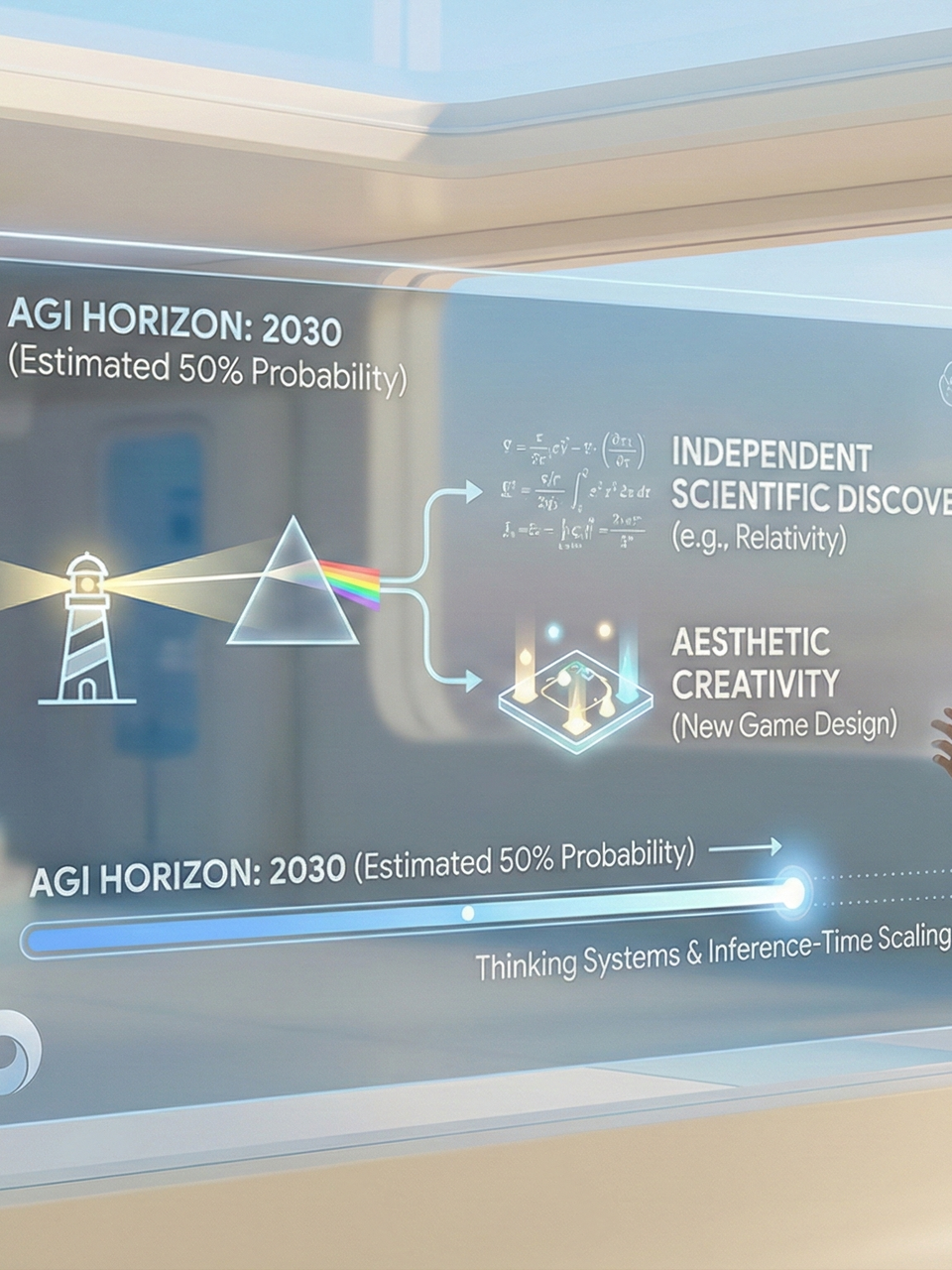
Beyond mere testing, the most definitive proof of AGI will likely come from "lighthouse moments" that mirror historical human breakthroughs.
"One such benchmark is the ability of an AI to produce a 'Move 37' moment in the realm of science or creativity."
Scientific Discovery: This would involve the AI inventing an entirely new conjecture or a hypothesis about physics. A specific, rigorous test would be a "back-test" where the system is provided with a knowledge cutoff of the year 1900 to see if it could independently derive the theories of special and general relativity as Einstein did.
Creative Invention: Another proposed benchmark is the invention of a game as deep, aesthetically beautiful, and elegant as Go. This requires the creative capacity to build a new system of strategy from scratch and explain its internal workings to human collaborators.
The Technical Engine: Scaling and "Thinking Systems"
The technical engine driving this progress is the continued application of scaling laws across three distinct pillars: pre-training, post-training, and inference-time compute.
Inference-Time Scaling: A new paradigm is emerging where AI systems get smarter the more "thinking time" or inference-time compute they are allocated at the moment of the task.
Data Optimism: Regarding data scarcity, Hassabis believes that while human data is valuable, the ability to create sophisticated simulations will allow AI to generate high-quality synthetic data to ensure the scaling process does not hit a wall.
Recursive Improvement: Current systems like AlphaEvolve are already exploring recursive self-improvement by optimizing code, such as faster matrix multiplication.
As the difficulty shifts from engineering to fundamental research, the importance of a deep research bench is paramount. Hassabis points out that 80% to 90% of the breakthroughs underpinning modern AI originally originated from Google Brain, Google Research, and DeepMind.
Physical Infrastructure and Energy
The physical infrastructure required for AGI also necessitates innovation in energy and hardware.
Hardware: Google continues to develop its own TPU line and is looking into inference-only chips to increase efficiency.
Energy Optimization: AI is already used for grid optimization and cooling system efficiency in data centers.
Future Breakthroughs: Hassabis expects AI to play a transformative role in climate and energy within the next five years, including helping with plasma containment for fusion reactors and discovering new materials for room-temperature superconductors or optimal batteries.
Summary: The journey toward AGI by 2030 is an empirical pursuit that balances the scaling of existing capabilities with "blue sky" research into new architectures. When an AI system can explain a new law of physics or invent a game of profound depth, we will have reached a moment comparable to the greatest achievements of human history.
Frequently Asked Questions
Qany questions?
Please read the article carefully. If you have any questions, please contact [email protected].
Audio synthesized by Entity-Echo AI Agent