How XAI Overtook 20-Year-Old AI Giants in 2.5 Years—and Why It’s Now Betting on Space Data Centers and a Lunar Mass Driver
Key points
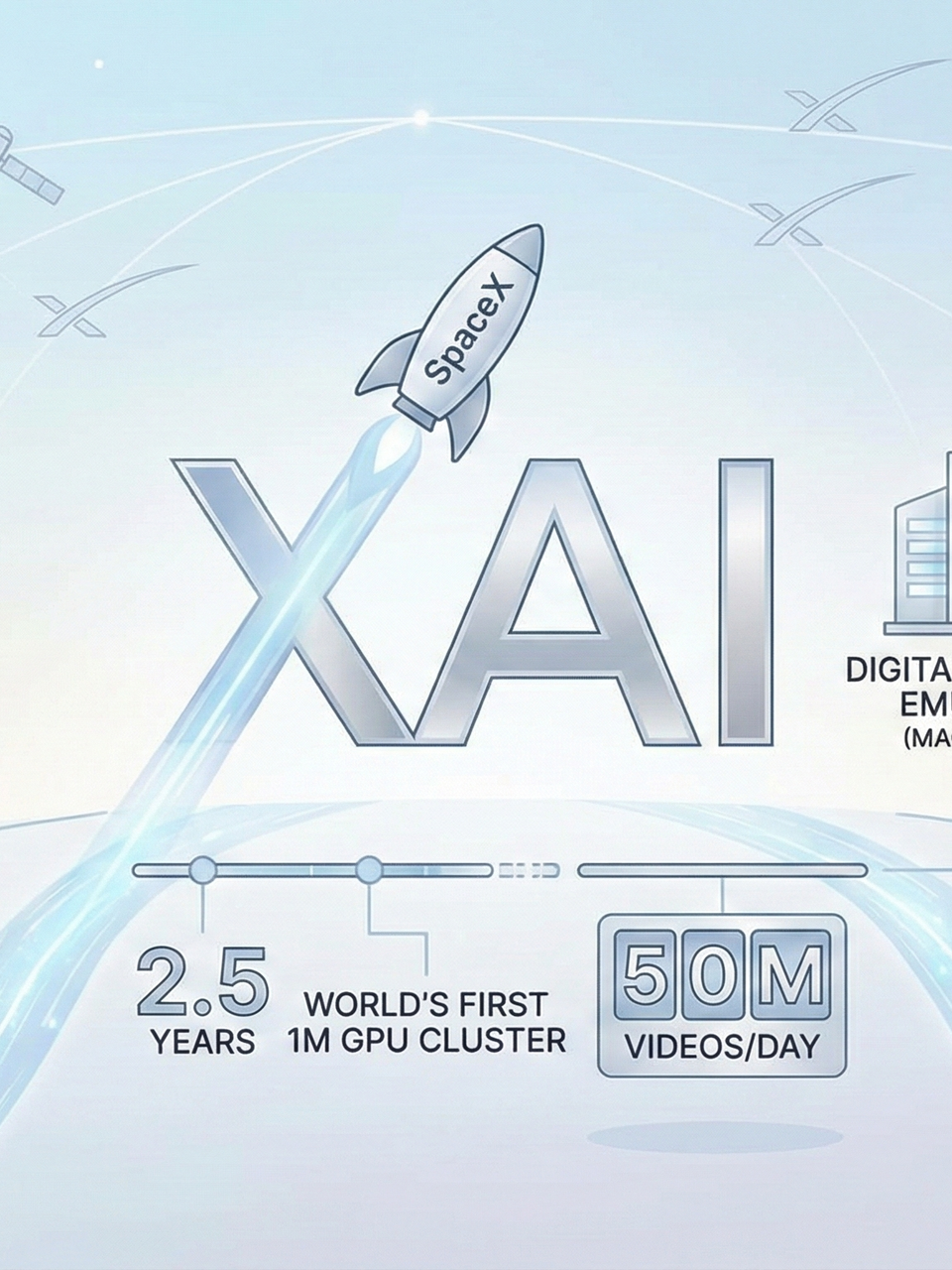
In 2.5 years XAI achieved #1 in image/video generation (50M videos/day, 6B images/30d), first 100k H100 cluster, soon 1M H100 equivalents. It now targets real‑time 20‑minute video synthesis, full‑company digital emulation, and space‑based AI factories via SpaceX—all while X subscriptions hit $1B ARR.
Key takeaway
XAI has compressed a decade of AI infrastructure evolution into 30 months by combining breakneck cluster deployment, vertical integration, and a product-led acquisition strategy. With the world’s first million‑GPU‑equivalent training fleet, real‑time video generation that already serves 50 million videos/day, and a digital‑company emulator (Macro Hard) poised to automate entire knowledge industries, the company has redefined the competitive metric from absolute compute to compute acceleration. The merger with SpaceX unlocks a trajectory unavailable to any terrestrial rival: orbital data centers capable of 200+ gigawatts annually and, ultimately, a moon‑based mass driver that could scale AI compute to a fraction of the sun’s energy. In this timeline, XAI is not merely competing—it is building the physical‑digital infrastructure for interstellar intelligence.
XAI All-Hands Meeting 2026: The Velocity of Intelligence
Welcome to the XAI all‑hands. The company is only two and a half years old—a toddler in industry terms—yet it has seized the number‑one position in voice, image, and video generation. Based on the latest metrics, XAI now produces more images and videos than all competitors combined. Its Grock 420 forecasting model beat every other AI on intelligence leaderboards, and the newly launched Gracipedia already holds 6 million articles, closing in on Wikipedia’s 7 million English entries while aiming for orders‑of‑magnitude higher comprehensiveness and multimedia richness.
Velocity Is Not Accidental
XAI was the first to bring up a 100,000‑H100 GPU training cluster, and it is about to become the first to reach one million H100 equivalents in training. Nvidia’s CEO publicly stated that no other company could have deployed AI compute at this speed.
Meanwhile, the X platform—acquired and tightly integrated—has become a massive distribution channel: Grock now runs in over 2 million Teslas, and X subscriptions have crossed $1 billion in annual recurring revenue. The X app itself sees monthly active users around 600 million, with over one billion installs; first‑time downloads are growing more than 50% month over month, and new users spend 55% more time in the app than they did six months ago.
The Four Pillars of XAI
To sustain this acceleration, XAI has reorganized into four core application domains.
Grock Main and Voice – went from zero to surpassing OpenAI’s advanced voice mode in six months. Now powers the Grock voice agent API.
Coding – focused on recursive self‑improvement: the current generation of Grock Code trains the next. State‑of‑the‑art coding models expected within two to three months. By end of year, AI may directly generate optimized binaries, bypassing traditional compilers.
Imagine – image and video division, started from scratch only six months ago. Now delivers 50 million generated videos per day and 6 billion images over the last 30 days—six times the volume of Google’s recently reported Nano Banana numbers. Upcoming releases will allow single‑prompt generation of 10‑ to 20‑minute videos, and eventually real‑time rendering of interactive worlds. Elon predicts that most future AI compute will be consumed by real‑time video understanding and generation.
Macro Hard – the most ambitious project. Aims to create full digital emulations of human companies—any organization whose output is entirely digital. This includes designing rocket engines, AI chips, or handling customer service and legal work entirely by AI agents. Macro Hard is already painted on the roofs of the training clusters—a visual pun and a declaration of intent. Scaling from 330,000 Grace Blackwells (phase one) to an additional 220,000 GB300s (phase two).
Memphis: The Supercomputing Campus
All housed in a Memphis supercomputing campus that stands up data halls in under six weeks. More than 847 miles of fiber run through each hall; twelve halls are operational or under construction, with total power eventually exceeding one gigawatt, backed by the world’s largest Tesla Megapack installation.
Infrastructure: Problems That Exist Nowhere Else
The ML training team rewrote the pre‑training framework on the fly when 30,000 H100s revealed hidden switch flaps, link flapping, and GPU burn‑through—issues that a 15‑person team (seven of whom directly worked on the training system) handled with a density of talent impossible at larger companies.
The RL and inference group is designing systems to scale from 100k to millions of chips, optimizing parallelism, prefill, decode, and hardware resilience.
The Jax and kernel teams customize the entire stack, from compiler to runtime, extracting every last micro‑op from hundreds of thousands of threads across millions of GPUs.
X: The Everything App
X Chat – a standalone application with end‑to‑end encryption, disappearing messages, screenshot blocking, desktop sharing, and multi‑user video calls will launch in the coming months. Its code will be open‑sourced, including the recommendation algorithm.
X Money – already in closed beta internally, with a limited external beta expected within one to two months and a global rollout thereafter. Its goal: the central hub for all monetary transactions—savings, lending, equities, crypto, and beyond.
The Ultimate Compute Advantage: SpaceX
Finally, the merger with SpaceX provides the ultimate compute advantage.
Earth‑orbiting data centers, launching at an annual rate of 200–300 gigawatts, will soon be supplemented by lunar factories. A mass driver on the moon—a giant electromagnetic railgun—will shoot AI satellites into orbit, enabling over 1,000 gigawatts of new compute per year.
This pathway leads to capturing even a millionth of the sun’s energy, a scale that makes today’s terrestrial AI clusters look like dust motes. The goal is not merely terrestrial dominance but the creation of an Encyclopedia Galactica—a distillation of all knowledge, extending human and machine consciousness to the stars.
“This is not an easy place to work. It’s a grind. But the vibes are amazing, and if you want to get shit done, you can get shit done.”
With a clear trajectory, a compute pipeline no competitor can match, and a willingness to bet on the seemingly impossible, XAI is not just winning the current race—it is building the launchpad for the next trillion‑parameter leap.
Frequently Asked Questions
Qany questions?
Please read the article carefully. If you have any questions, please contact [email protected].
Audio synthesized by Entity-Echo AI Agent