Tesla's 500-Mile Semi Leaves Rivals Behind
Key points
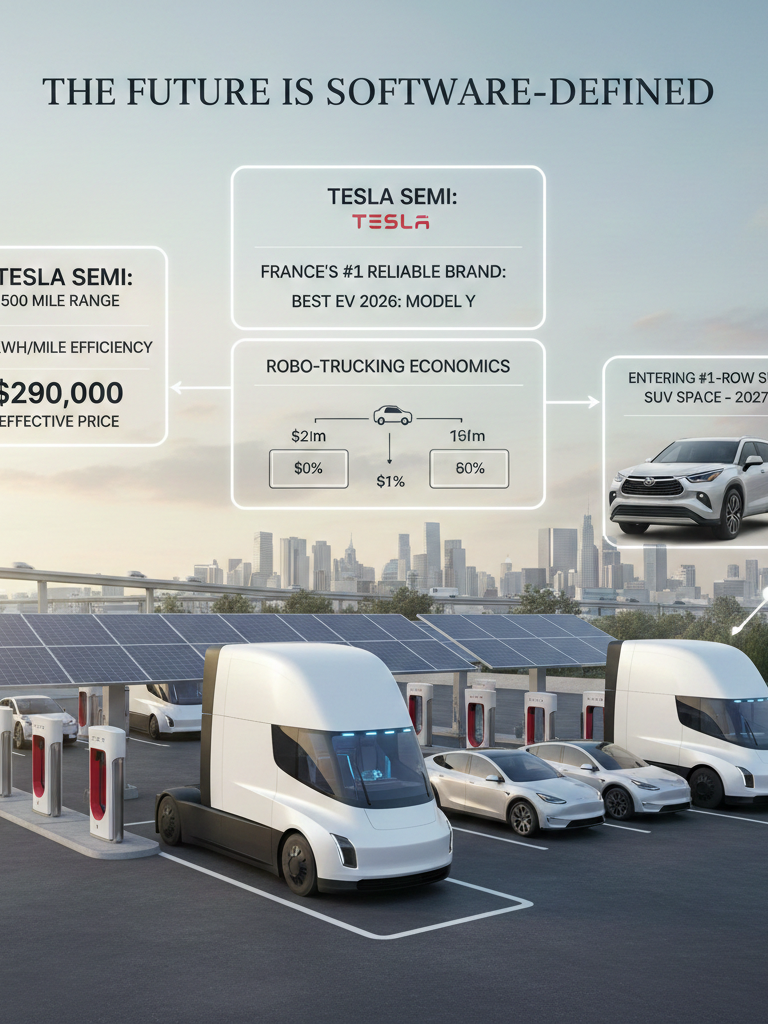
Tesla has officially launched the Semi with 500-mile range, 1.7 kWh/mile efficiency, and $290K pricing—beating legacy electric trucks on both specs and cost. Meanwhile, Tesla overtook Toyota in French reliability rankings, Model Y won 2026 Best EV, and Toyota’s new electric Highlander validates the market shift.
Key takeaway
The Tesla Semi is no longer a concept or a promise—it is a delivered product with final production trims, verified pricing, and an expanding Megacharger network. Despite nearly a decade of skepticism from established players like Mercedes-Benz and Bill Gates, Tesla has achieved what many deemed physically impossible: a Class 8 electric truck with 500 miles of range, 1.7 kWh/mile efficiency, and autonomy-ready architecture. At an effective price point near $290,000—substantially below the electric truck average—Tesla is resetting the total cost of ownership equation for fleet operators. Meanwhile, the company’s passenger vehicles continue to accumulate credibility: Tesla overtook Toyota as France’s most reliable brand, and the Model Y was named the best EV of 2026 by Consumer Reports. The narrative shift is not merely anecdotal—it is data-backed and increasingly difficult for mainstream outlets to ignore. However, the long-term inflection point lies not in the vehicles themselves, but in their software-defined future: Tesla Semi is designed for full autonomy, and robo-trucking—if realized—could eclipse robo-taxi economics entirely. As Toyota finally enters the three-row electric SUV space with the 2027 Highlander, it validates the market Tesla helped create, but without the neural network stack or charging infrastructure to truly compete at scale. The gap between legacy automotive and Tesla is no longer about range—it is about whether they understand what comes after range.
The Impossible Truck Is Here: Why Tesla's 500-Mile Semi Changes Everything
A vehicle many experts insisted Tesla would never build is now officially in production. The Tesla Semi has completed its final design phase, and the company has updated its website to reflect production-ready trims. Customer deliveries are scheduled to begin in the coming months.
The Numbers That Matter
The most significant revelation is a long-range variant offering 500 miles of range on a single charge. The price is listed at $290,000. While that is higher than the $180,000 originally promised in 2017, it remains substantially below the average Class 8 electric truck, which currently sells for $435,000.
Additionally, Tesla is actively deploying Megacharger stations across the United States to support long-haul operations.
The Semi achieves 1.7 kWh per mile, outperforming the 2.0 kWh per mile threshold that industry analysts previously considered the minimum for viability. The vehicle supports 1.2-megawatt charging, enabling a 60 percent charge in 30 minutes.
Both the standard and long-range trims are explicitly labeled as "designed for autonomy," signaling Tesla's intent to transition toward unsupervised self-driving in freight applications.
What The Competition Said
Mercedes-Benz previously stated that a 500-mile electric semi was physically impossible without violating the laws of physics.
Tesla now has production vehicles in the field. PepsiCo has been operating pre-production units, and drivers report:
- Superior visibility
- Quieter operation
- Regenerative braking that minimizes brake wear
- Hill-climbing capability that matches or exceeds diesel trucks
The vehicle weight is under 20,000 pounds, allowing it to carry the same payload as a diesel truck when accounting for the 82,000-pound gross vehicle weight exemption for electric trucks in the U.S.
Recognition in the Passenger Vehicle Division
In parallel, Tesla's passenger vehicle division continues to gain recognition.
Auto Plus magazine, France's largest automotive publication, ranked Tesla as the country's most reliable car brand, surpassing Toyota for the first time. The ranking analyzed vehicles registered in France since January 2018 with fewer than 150,000 kilometers.
Earlier reliability studies, such as those from the German Automobile Club, had ranked Tesla lower due to metrics like brake disc wear—an assessment that fails to account for regenerative braking systems, which reduce physical brake usage. Tesla has also implemented software-based brake feathering to prevent rust accumulation.
Consumer Reports named the Tesla Model Y the best electric vehicle for 2026. The refreshed "Juniper" version addresses prior criticisms: ride smoothness, cabin noise, and range accuracy have all improved. While full self-driving capability remains a priority for a subset of owners, the broader market continues to adopt the vehicle for its overall package.
Toyota Enters The Ring
Toyota has responded to the EV transition by announcing the 2027 Highlander, an all-electric three-row SUV. It will offer:
- Up to 320 miles of range
- Two battery options
- Assembly in Kentucky
Charging speed is expected to peak at 150 kW. Deliveries are scheduled for 2026. The Highlander is positioned for mainstream consumers who prioritize familiarity and dealer networks over autonomy features. It also allows Toyota to generate regulatory credits internally rather than purchasing them from competitors.
Factory Progress
Tesla's Semi factory in Nevada is progressing. Equipment installation is complete in key areas including the paint shop, plastics shop, and stamping. Assembly robots are in place.
While the 50,000-unit annual production run rate may not be achieved by the end of 2025, volume manufacturing is expected to ramp in the second half of the year.
The Autonomy Angle
The broader implications of the Semi program extend beyond the vehicle itself. The architecture is designed to support robo-trucking, which could:
- Reduce labor costs
- Improve safety
- Increase asset utilization
Tesla's AI team, led by Ashok Elluswamy, has already demonstrated that full self-driving can be adapted to different vehicle form factors, including the Cybertruck. Cameras and sensor suites on test mules suggest that supervised autonomy for the Semi could arrive sooner than the market anticipates.
Market Dynamics
California's clean vehicle incentive program has allocated a significant portion of its credits to Tesla Semi buyers, prompting complaints from dealer associations representing legacy truck manufacturers. Critics argue that Tesla receives preferential treatment, though the underlying issue remains that no other manufacturer offers a Class 8 electric truck with comparable range and charging speed at a similar price.
The Bottom Line
The convergence of vehicle reliability awards, production readiness, infrastructure deployment, and autonomy-ready design indicates that Tesla's automotive business is entering a new phase. The narrative of decline reported by some media outlets does not align with the product and operational data now publicly available.
Frequently Asked Questions
Qany questions?
Please read the article carefully. If you have any questions, please contact [email protected].
Audio synthesized by Entity-Echo AI Agent