Why Elon Musk Predicts AI and Humanoid Robots Will Crash Costs to Zero—and Why Regulations Could Stall Everything by 2026?
Key points
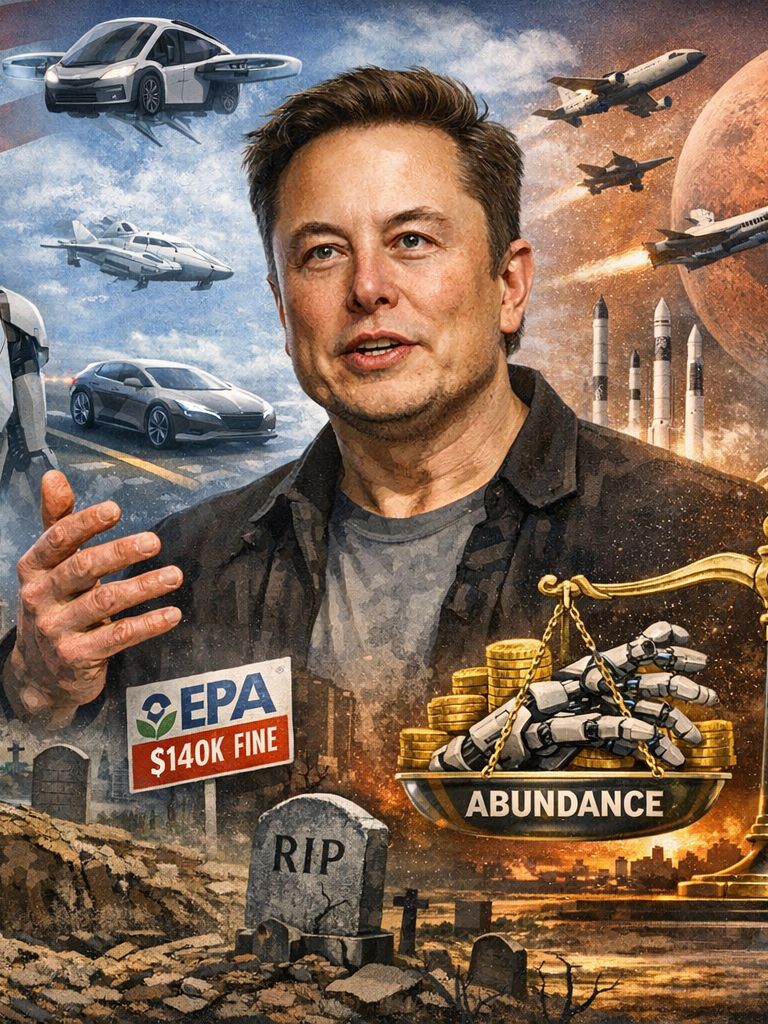
Musk forecasts AI+robotics will push goods/services costs near zero, with 2:1 humanoid‑to‑human ratio, 22‑DOF Optimus hand. Cites $140k EPA water fine, $1T+ interest on debt, and 80% probability of an abundant future—if regulations don’t stall innovation.
Key takeaway
Elon Musk argues that the convergence of general-purpose humanoid robots and autonomous vehicles will drive the cost of manufactured goods and services asymptotically toward zero, creating an age of abundance where scarcity is artificially defined. He estimates a humanoid-to-human ratio of at least 2:1, with the Optimus robot’s next-generation hand achieving 22 degrees of freedom—closely mimicking human dexterity. However, Musk warns that unchecked regulatory accumulation, citing a $140,000 EPA fine against SpaceX for discharging fresh water, combined with U.S. debt interest payments exceeding $1 trillion annually (now surpassing the defense budget), could derail progress. He contrasts government‑dependent contractors (e.g., Boeing) with commercially driven firms (SpaceX, 80% commercial revenue) and frames AI’s trajectory as 80% likely to deliver abundance and 20% existential risk. The path to Mars, he insists, requires both regulatory pruning and fiscal responsibility—or the U.S. risks “whistling past the graveyard.”
Elon Musk Interview: AI, Humanoid Robots, Regulations, and the Path to Mars
The Abundance Thesis: When Costs Vanish
In a wide‑ranging interview, Elon Musk laid out his most detailed vision yet of how artificial intelligence and robotics will reshape the global economy—and why out‑dated regulations and fiscal drift could slow humanity’s expansion into space.
Musk opened with a provocative thesis: once general‑purpose humanoid robots and autonomous vehicles reach scale, “you can build anything.” He argued that the cost of any manufactured good or provided service will trend toward zero, constrained only by artificially scarce items like unique artwork. The economic implication is staggering: if average productivity per person—or per robot—rises without limit, the economy itself faces no natural ceiling.
Musk estimates the ratio of humanoid robots to humans will be at least 2:1, possibly 3:1, with many robots operating unseen in production.
Optimus: Closing the Dexterity Gap
To make this concrete, he detailed the evolution of Tesla’s Optimus robot.
- Current hand: 11 degrees of freedom, actuators inside the palm.
- Next‑generation prototype: actuators move to the forearm—exactly as human anatomy does—achieving 22 degrees of freedom operated by cables.
This, Musk believes, is sufficient to perform almost any task a human can, closing the dexterity gap.
The Speed of AI
He placed the rate of AI improvement far ahead of any prior technology: a basic open‑source large language model running on a Raspberry Pi can now beat the Turing test.
“The good future of AI is one of immense prosperity—80% likely. The other 20% I try not to think about before bed.”
Regulatory Strangulation: The $140,000 Water Fine
Yet Musk’s optimism is tempered by his critique of governance. He used SpaceX’s recent $140,000 fine from the EPA as a case study in irrational regulation.
The charge? Discharging potable water—actually fresh water used to cool a launch pad—without a permit. The site, Starbase, sits in a tropical thunderstorm zone; water falls from the sky constantly. The EPA admitted no harm was done, yet demanded payment and held launch licenses hostage.
“It’s a ransom. At this rate, we’ll never get to Mars.”
He tied this to a broader pattern: cumulative regulation that, over 40 years since the Reagan‑era deregulation push, has made “everything illegal.”
Fiscal Drift: Whistling Past the Graveyard
The U.S., he warned, is also going bankrupt “extremely quickly.”
- Interest payments on the national debt have just surpassed the Department of Defense budget—over $1 trillion per year.
- The debt itself grows by another trillion every three months.
“Everyone’s grabbing the silverware before the Titanic sinks.”
Economic Systems: Walls Don’t Lie
Contrasts between economic systems emerged as a recurring theme. Musk pointed to North vs. South Korea and East vs. West Germany: identical populations, vastly different outcomes.
“The system that has to build a wall to keep people in is the bad system.”
He noted that Cuba has plenty of boats available to return to the island—yet no one takes them.
Boeing vs. SpaceX: Culture and Competence
When asked why Boeing’s Starliner has struggled while SpaceX succeeds, Musk attributed it to cultural capture.
- Boeing derives so much revenue from government that it has “impedance match” to Washington; its previous CEO held an accounting degree and never visited the factory.
“If you’re the cavalry captain, you should know how to ride a horse.”
- SpaceX, by contrast, generates most of its revenue commercially—contrary to popular assumption—and that market discipline forces efficiency.
He acknowledged that rocket technology is legally classified as an advanced weapons system, preventing SpaceX from simply moving operations to a faster jurisdiction.
“I wish people were trying to steal it. No one is—it’s too crazy.”
Content Moderation and Brazilian Law
The conversation also touched on content moderation and international law. Musk insisted that X Corp. aims only to follow local statutes.
In Brazil, he said, the company perceived it was being asked to violate Brazilian law—something no American firm can do quietly.
“If speech isn’t illegal, what are we doing? Injecting ourselves as censor—and where does that stop?”
He argued that governments should change laws if they want different outcomes; platforms should simply enforce what is written.
Saturday Night Live: The Sketch That Almost Was
Interwoven with these weighty topics was a rare, self‑deprecating anecdote about Musk’s 2021 Saturday Night Live appearance.
He and the writers pitched a bit to prove the show is truly live: he would walk onstage, drop the script, and—mid‑sentence—unzip his pants.
“If you see my car, it’s true. If you don’t, it’s been a lie all these years.”
NBC’s lawyers killed the sketch. Musk’s mock response:
“It’s okay—Elon called Comcast and made an offer. They accepted. We own NBC now.”
The deadpan delivery, he said, convinced even Colin Jost for a moment.
Inspiration: Why We Need Starfleet Academy
Ultimately, Musk returned to the theme of inspiration. He argued that children need futures that excite them: being an astronaut on Mars, traveling beyond the solar system, making Starfleet Academy real.
“Life can’t just be solving one miserable problem after another.”
The combination of AI‑enabled humanoid robots and commercial spaceflight, in his view, is the most compelling such story—provided the regulatory noose is loosened and the fiscal ship is righted. Without both, he suggested, humanity may remain Earth‑bound, suffocated by red tape and debt.
Frequently Asked Questions
Qany questions?
Please read the article carefully. If you have any questions, please contact [email protected].
Audio synthesized by Entity-Echo AI Agent