Why Is 2026 the Year the Future Materializes and How Will AGI Redefine Human Purpose?
Key points
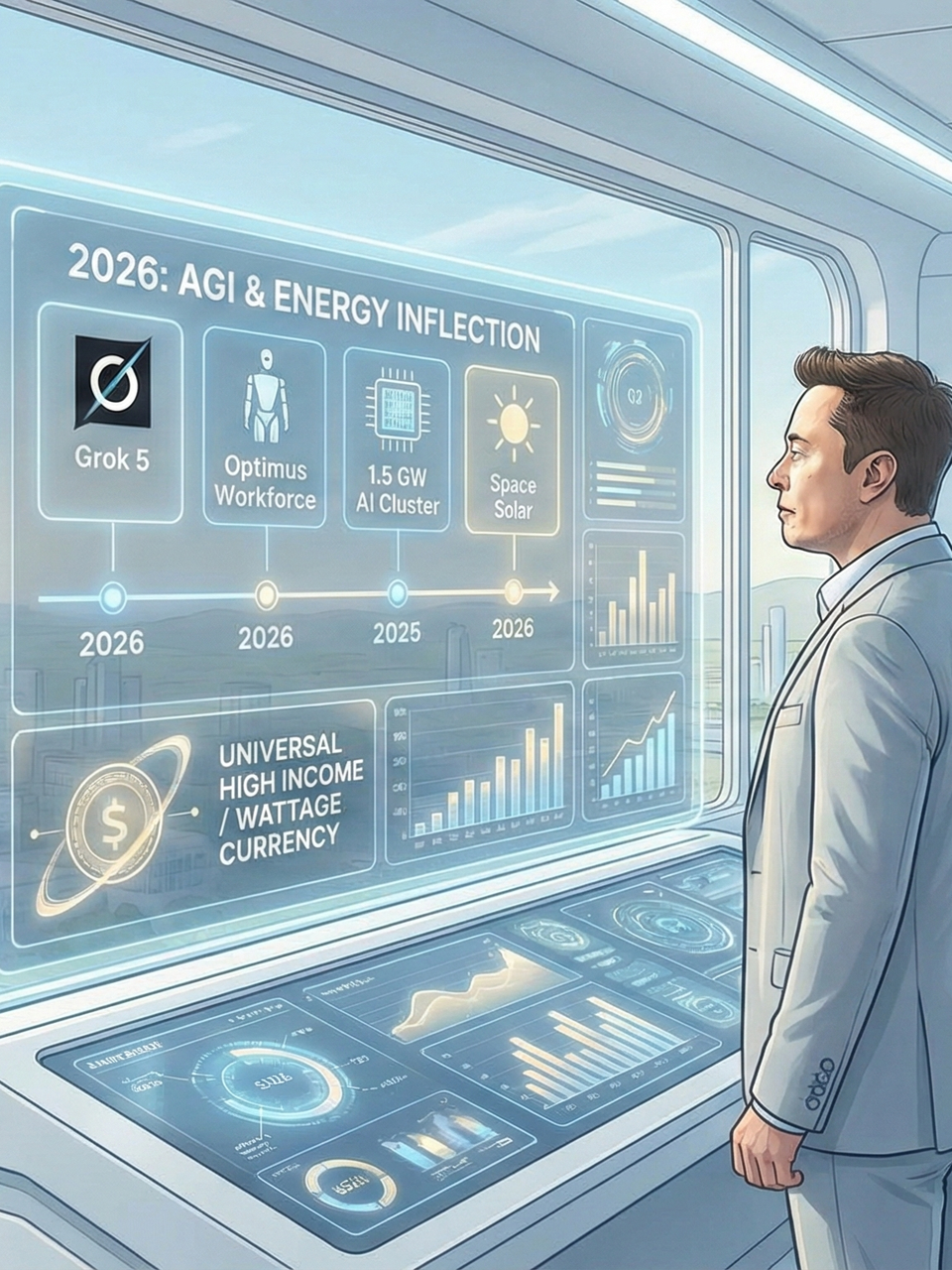
Elon Musk forecasts Grok 5 arriving in Q1 2026, robotic surgeons surpassing humans within three years, and a 100 gigawatt space solar infrastructure. He warns of a looming chip wall and electricity bottleneck, suggesting that wattage will become the future's primary currency while retirement savings become irrelevant.
Key takeaway
The year 2026 represents a critical inflection point where digital intelligence and physical robotics converge to shatter traditional economic models. Elon Musk predicts that we are entering an era of universal high income where the cost of goods and services collapses due to massive productivity gains. However, this transition will be a bumpy ride characterized by simultaneous prosperity and social unrest. To survive and thrive, humanity must steer AI toward being maximally truth seeking while shifting our focus from labor to curiosity. Ultimately, the survival of our civilization depends on climbing the Kardashev scale by harnessing solar energy and becoming a multiplanetary species before our biological window closes.
Why Is 2026 the Year the Future Materializes and How Will AGI Redefine Human Purpose?
In a definitive 2026 interview, Elon Musk outlines a world where the distinction between science fiction and reality has effectively vanished. We are currently witnessing the materialization of the future through three multiplied exponentials: software capability, chip performance, and electromechanical dexterity.
The Intelligence Explosion and the New Workforce
Musk predicts that by 2030, and perhaps much sooner, AI will exceed the intelligence of all humans combined. Grok 5 is slated for release in Q1 2026, aiming for near perfect scores on the Human Last Examination. This level of intelligence is not just a digital tool but a fundamental shift in how atoms are shaped.
The workforce is on the brink of a total transformation. Musk asserts that any job involving digital information, especially white collar work, can be replaced by AI right now. While inertia keeps many companies afloat, AI centered firms will soon demolish traditional competitors. Within three years, Optimus robots will perform micro surgery with greater precision than the best human surgeons. Musk views the estimate of 10 billion humanoid robots by 2040 as a low number, suggesting that robots will eventually outnumber humans and saturate all human desires for goods and services.
Universal High Income and the Energy Loop
This leads to the concept of Universal High Income and Universal High Stuff. As the cost of labor and intelligence drops to near zero, the production of goods will increase by high double digits. This massive productivity is the only way to prevent national bankruptcy, as the interest on US debt now exceeds 1 trillion dollars, surpassing the military budget and Medicare. Musk advises that saving for retirement in 10 or 20 years will be irrelevant because the basic rules of money and work are being rewritten. In this new economy, the primary currency will be wattage.
Energy is the innermost loop of progress. China is already leading this race, expected to pass three times the US electricity output in 2026. China’s production capacity for solar is approximately 1,500 gigawatts per year. Musk advocates for a massive scale up of solar and battery storage in the US to double energy throughput without new power plants. Beyond Earth, he proposes a path to 100 gigawatts of space solar per year using solar powered AI satellites. This would involve 10,000 Starship flights annually, delivering a million tons of payload to orbit. Each Starship already expends over 100 gigawatts of power on ascent, a feat Musk describes as being at the limit of biological intelligence.
Infrastructure & Bottlenecks
| Feature | Target / Metric | Timeline |
|---|---|---|
| xAI Training Cluster | 1 Gigawatt (Colossus 2) | Mid-January 2026 |
| xAI Peak Cluster | 1.5 Gigawatts | April 2026 |
| Humanoid Surgeons | Superior to all humans | ~3 Years |
| US Debt Interest | >$1 Trillion | Current (2026) |
Longevity, Education, and the Simulation
However, a chip wall is approaching. Even as chip output grows, the ability to power and cool these chips is the immediate bottleneck. XAI is addressing this with Colossus 2 in Memphis. This infrastructure is necessary because intelligence density potential is still two orders of magnitude higher than what we currently experience. Musk notes that the speed of light will prevent a single AI mind from dominating, leading to a landscape of multiple competing AIs from Google, XAI, and China.
On the topic of human longevity, Musk has shifted his perspective. He now believes doubling the human lifespan is an extremely solvable problem. Because the human body ages synchronously, the biological clock is obvious and programmable. While he previously argued that people must die for ideas to change, he now sees a significant increase in health span as likely within the next 10 years. This is crucial as countries like Japan and South Korea face severe underpopulation, with adult diaper sales already exceeding baby diaper sales. Increasing the productive life of citizens by even a few years could flip global economics.
Education is also being redesigned. Musk’s project in El Salvador uses Grok as an individualized, infinitely patient teacher. He argues that traditional college is now primarily for social experience rather than learning. Unless a student is there for the social aspect, independent learning via AI is more efficient. He views the brain as a biological meat computer and admits that while AI can make learning more interesting, it cannot force curiosity.
Conclusion: A Cautious Optimist's Future
Musk remains a cautious optimist. He emphasizes that AI safety depends on three pillars: truth, curiosity, and beauty. If AI is programmed to be maximally truth seeking and curious about the universe, it will naturally foster humanity. He speculates that we may be living in an nth generation simulation, noting that only interesting simulations survive truncation. To ensure our reality remains interesting, we must lift our gaze toward the stars. A permanently crewed moon base is the immediate priority, followed by a Mars shot in 2028 or 2029.
In summary, the next two years will see a shitload of robots and the arrival of AGI. We are moving toward a Kardashev Scale civilization, where we must harness a millionth of the sun's energy to sustain our growth. While the transition will be bumpy and may cause social unrest, the alternative is economic doom. Musk's transition from a spectator to a participant in AI development is driven by the desire to steer this supersonic tsunami toward a Star Trek future rather than a Terminator collapse. The goal is a world of abundance where anyone can learn anything for free and access medical care better than what any president receives today.
Frequently Asked Questions
Qany questions?
Please read the article carefully. If you have any questions, please contact [email protected].
Audio synthesized by Entity-Echo AI Agent